

Handheld Oscilloscope Review and Comparison: Best Portable Oscilloscopes in 2026
23/01/2026, hardwarebee
Handheld oscilloscopes have quietly moved from “nice-to-have gadgets” to serious measurement tools. If you’re doing field diagnostics, on-site maintenance, education, or quick bench checks without dragging a full lab scope around, a handheld oscilloscope can save time, money, and frustration.
This article is written specifically for engineers, technicians, educators, and buyers who are actively comparing handheld oscilloscopes. We’ll break down what actually matters, review the major vendors and popular models, and end with a clear comparison table to help you decide.
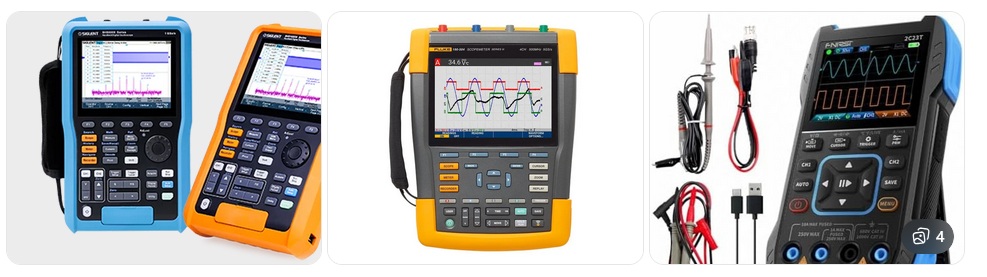
What Is a Handheld Oscilloscope (and What It Is Not)
A handheld oscilloscope is a battery-powered, portable oscilloscope designed to be used without a PC or external power. Unlike USB oscilloscopes or benchtop scopes, handheld models integrate:
- Display
- Controls
- Acquisition hardware
- Battery
into a single rugged device.
What they are great at
- Field service & troubleshooting
- Power electronics debugging
- Education & labs on the move
- Quick signal verification
What they are not
- Ultra-high bandwidth RF analysis
- Deep memory protocol decoding
- Replacement for a 4–8 channel lab scope
If you know these limits, handheld scopes can be incredibly effective.
Key Buying Criteria When Comparing Handheld Oscilloscopes
Before looking at brands and models, here are the non-negotiables you should compare.
1. Bandwidth & Sample Rate
Most handheld oscilloscopes sit between 20 MHz and 200 MHz. For power electronics and embedded work, 50–100 MHz is usually sufficient.
Rule of thumb:
Bandwidth ≥ 5× your highest signal frequency
2. Channels
- 2 channels is standard
- Some premium models offer 4 channels, but battery life and cost suffer
3. Isolation & Safety
This is where handheld scopes shine:
- Floating inputs
- CAT II / CAT III ratings
- Safe measurements on mains-referenced systems
For field and industrial work, this matters more than raw bandwidth.
4. Battery Life
Expect anywhere from 2 to 6 hours depending on brightness, sampling rate, and active features.
5. Extra Functions
Many handheld oscilloscopes integrate:
- Multimeter (DMM)
- FFT / spectrum view
- Data logging
- Signal generator
Sometimes these features are more valuable than higher bandwidth.
Major Handheld Oscilloscope Vendors
Let’s look at the brands that actually matter in this space.
🔹 Fluke
Fluke dominates professional field measurement. Their handheld oscilloscopes are expensive but extremely robust, with excellent isolation and safety certifications.
Strengths
- Industry-leading safety
- Excellent build quality
- Trusted by electricians & industrial techs
Weakness
- Price
- UI feels conservative compared to newer brands
🔹 Tektronix
Tektronix brings lab-grade signal fidelity into portable form factors. Their handheld offerings focus on accuracy rather than “all-in-one” gimmicks.
Strengths
- Clean signal acquisition
- Strong triggering performance
Weakness
- Fewer integrated features
- Higher cost
🔹 Siglent
Siglent has aggressively pushed value-for-money oscilloscopes, including portable and semi-handheld designs.
Strengths
- High bandwidth at lower price
- Modern UI
Weakness
- Less rugged than Fluke
- Not always CAT-rated for harsh environments
🔹 OWON
OWON is popular in education and hobbyist markets and offers some of the cheapest true handheld oscilloscopes.
Strengths
- Very affordable
- Lightweight
- Good for basic measurements
Weakness
- Limited bandwidth
- UI and trigger stability vary by model
🔹 Hantek
Hantek targets entry-level and mid-range users with aggressive pricing and broad availability.
Strengths
- Low cost
- Decent specs on paper
Weakness
- Build quality
- Firmware maturity
Popular Handheld Oscilloscope Models (Real-World Perspective)
Below are models that buyers actually compare when searching for “handheld oscilloscope”.
Fluke 190-Series II
- Bandwidth: up to 200 MHz
- Channels: 2 or 4
- CAT III / CAT IV safety
- Long battery life
This is the gold standard for industrial field work.
Tektronix THS3000 Series
- Bandwidth: 100–200 MHz
- Excellent isolation
- High-quality display
More “engineer-focused” than electrician-focused.
Siglent SHS800X
- Bandwidth: 100 MHz
- Integrated multimeter
- Strong value pricing
A solid middle ground between professional and budget.
OWON HDS Series
- Bandwidth: 25–60 MHz
- Oscilloscope + DMM combo
- Entry-level pricing
Good for students and light field diagnostics.
Hantek 2D Series
- Budget handheld scope + DMM
- Limited bandwidth
- Best for basic troubleshooting
Handheld Oscilloscope Comparison Table
| Vendor | Model | Bandwidth | Channels | Sample Rate | Battery | Notable Features | Typical Use Case |
|---|---|---|---|---|---|---|---|
| Fluke | 190-204 | 200 MHz | 4 | 2.5 GS/s | ~4 h | CAT IV, isolated inputs | Industrial field service |
| Tektronix | THS3202 | 200 MHz | 2 | 2.5 GS/s | ~3 h | Excellent triggering | Engineering diagnostics |
| Siglent | SHS810X | 100 MHz | 2 | 1 GS/s | ~4 h | DMM, FFT | Embedded & power |
| OWON | HDS272S | 70 MHz | 2 | 250 MS/s | ~6 h | Scope + DMM | Education & hobby |
| Hantek | 2D72 | 70 MHz | 2 | 250 MS/s | ~4 h | Budget all-in-one | Basic troubleshooting |
Handheld vs Portable vs USB Oscilloscopes (Quick Reality Check)
A lot of buyers confuse these categories, so let’s be clear:
- Handheld oscilloscope → standalone, battery-powered, rugged
- Portable oscilloscope → often just a small benchtop scope
- USB oscilloscope → needs a PC or tablet
If you’re searching for “handheld oscilloscope comparison”, you likely want standalone operation, not a laptop-dependent solution.
Who Should Buy a Handheld Oscilloscope?
You should seriously consider a handheld oscilloscope if you:
- Work on-site or in the field
- Debug power electronics or mains-connected systems
- Teach electronics outside a fixed lab
- Need fast diagnostics without setup time
You should not buy one if:
- You need >500 MHz bandwidth
- You do protocol decoding daily
- You want deep memory analysis
Final Verdict: Are Handheld Oscilloscopes Worth It?
Yes—if you choose the right one.
For industrial and safety-critical work, Fluke and Tektronix still justify their price. For engineers, educators, and startups, Siglent, OWON, and Hantek offer compelling alternatives that cover 80% of real-world needs at a fraction of the cost.







 Partner with us