

Tektronix MDO34 Review: Mixed Domain Oscilloscope for Serious Debugging
23/01/2026, hardwarebee
As test systems become more complex, engineers are increasingly forced to debug problems that live across domains: time, frequency, digital, and analog. This is exactly where the Tektronix MDO34 positions itself.
The Tektronix MDO34 is part of the MDO3 Series — a Mixed Domain Oscilloscope that integrates a high-performance oscilloscope, logic analyzer, protocol analysis, and a full spectrum analyzer into a single instrument. In this article, we’ll look at what the MDO34 actually delivers in practice, who it’s for, and how it compares to traditional oscilloscopes and portable solutions.
What Is the Tektronix MDO34?
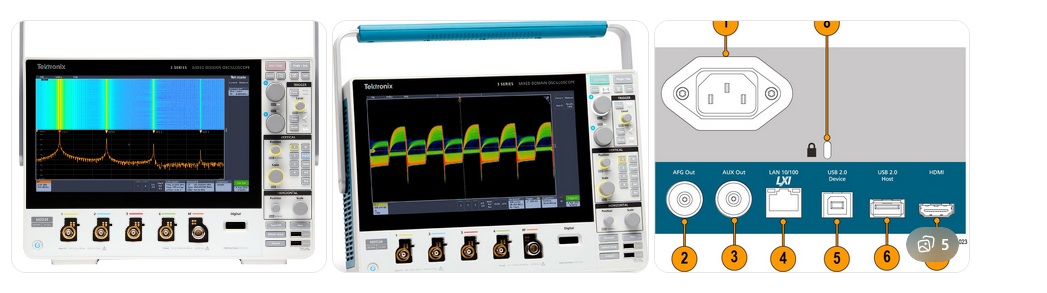
The Tektronix MDO34 is a 4-channel, 350 MHz oscilloscope with an integrated RF spectrum analyzer. Unlike add-on FFT views found in many scopes, the MDO34 includes true hardware-based spectrum analysis, enabling simultaneous time-domain and frequency-domain measurements.
At a high level, the MDO34 combines:
- 4-channel analog oscilloscope
- Digital logic analysis (MSO option)
- Protocol decoding (I²C, SPI, UART, CAN, LIN, etc.)
- Integrated spectrum analyzer (up to 3 GHz)
- Optional arbitrary/function generator
This makes it a single-box debug platform, rather than “just another oscilloscope.”
Key Specifications at a Glance
- Analog bandwidth: 350 MHz
- Channels: 4 analog (+ 16 digital optional)
- Sample rate: up to 2.5 GS/s
- Record length: up to 10 M points
- Spectrum analyzer: up to 3 GHz
- Display: 11.6″ HD touchscreen
- Form factor: Benchtop (not handheld)
From a spec standpoint, the MDO34 clearly targets professional labs, not entry-level users.
What Makes the MDO34 Different?
1. True Mixed-Domain Debugging
Most oscilloscopes can approximate frequency-domain analysis using FFT. The MDO34 goes much further.
You can:
- Trigger on an RF event
- Correlate RF bursts with digital bus activity
- View time-aligned spectrum and waveform data
This is extremely valuable for:
- Wireless + MCU co-design
- EMI troubleshooting
- IoT and RF-enabled embedded systems
Instead of guessing whether a firmware event caused an RF glitch, you can see it happen.
2. Excellent Triggering (Classic Tektronix Strength)
Tektronix oscilloscopes are known for their trigger reliability, and the MDO34 continues that tradition.
Triggering options include:
- Advanced edge and pulse triggers
- Serial protocol triggers
- RF power and frequency triggers
In real debugging scenarios, this often matters more than raw bandwidth.
3. User Interface and Display Quality
The large touch-enabled HD display is not just cosmetic. It allows:
- Split-screen domain views
- Drag-and-drop measurements
- Fast navigation through deep memory
Compared to older-generation scopes, the MDO34 feels modern and fluid, especially during long debug sessions.
How the MDO34 Fits into a Test Setup
It’s important to be honest here: the MDO34 is not a handheld oscilloscope and is not intended for field service.
Instead, it shines in:
- R&D laboratories
- Product validation and bring-up
- EMI pre-compliance debugging
- RF-enabled embedded systems
If your workflow involves bench + RF + digital work, the MDO34 can replace multiple instruments.
MDO34 vs Traditional Oscilloscopes
Compared to a Standard 300–500 MHz Scope
Advantages
- Integrated spectrum analyzer
- Better correlation between domains
- Reduced need for external RF tools
Trade-offs
- Higher price
- Slightly larger footprint
For purely analog debugging, a traditional scope may be sufficient. Once RF enters the picture, the MDO34 pulls ahead quickly.
MDO34 vs Handheld Oscilloscopes
This comparison matters if your blog already covers handheld scopes.
| Aspect | Tektronix MDO34 | Handheld Oscilloscope |
|---|---|---|
| Portability | ❌ Benchtop | ✅ Battery powered |
| Bandwidth | 350 MHz | 20–200 MHz |
| RF Analysis | ✅ True spectrum analyzer | ❌ FFT only |
| Safety CAT Rating | Lab use | Often CAT III/IV |
| Use Case | R&D & validation | Field diagnostics |
In short: they solve different problems. The MDO34 is for deep analysis; handheld scopes are for access and safety.
Strengths and Limitations
Strengths
- True mixed-domain capability
- Excellent triggering and signal integrity
- High-quality UI and display
- Reduces instrument count on the bench
Limitations
- Price (clearly premium)
- Not portable
- Overkill for simple analog tasks
If you don’t need RF correlation, you may never unlock the MDO34’s full value.
Who Should Consider the Tektronix MDO34?
You should seriously consider the MDO34 if you work with:
- Wireless embedded systems
- Power electronics with EMI concerns
- Complex MCU + RF interactions
- Pre-compliance testing
You probably should not choose it if:
- You only do basic analog measurements
- You need portability
- Budget is the primary driver
Final Verdict: Is the Tektronix MDO34 Worth It?
The Tektronix MDO34 is not trying to be everything to everyone — and that’s a good thing.
It’s a focused, professional instrument built for engineers who need to understand how analog, digital, and RF behaviors interact in real systems. If that describes your work, the MDO34 can save enormous time by eliminating blind spots between domains.







 Partner with us