

Nearshore vs Offshore FPGA Design Services | Find FPGA Development Partners
21/03/2026, hardwarebee
Choosing the right FPGA design partner is not only a technical decision but also a strategic one that can directly impact project timelines, cost efficiency, and development risk. Companies evaluating FPGA outsourcing often need to decide between nearshore and offshore engineering teams, each offering different advantages in terms of collaboration, pricing, and execution model.
FPGA development is fundamentally different from many other outsourced engineering disciplines. It involves complex hardware architecture, RTL design, high-speed interface integration, and hardware bring-up — all of which require tight coordination between teams. Unlike pure software projects, many FPGA issues only appear during system integration or on physical hardware, making communication and responsiveness critical.
Finding FPGA Design Experts with HardwareBee
HardwareBee provides a platform where companies can identify FPGA engineering providers specializing in Intel FPGA technologies.
By connecting companies with experienced design teams, HardwareBee helps organizations accelerate development timelines and reduce the risks associated with complex FPGA projects.
Organizations working on applications such as FPGA data acquisition systems or high-speed signal processing platforms must carefully balance cost with execution quality. HardwareBee helps companies evaluate FPGA design service providers globally, making it easier to choose the right collaboration model based on project requirements.
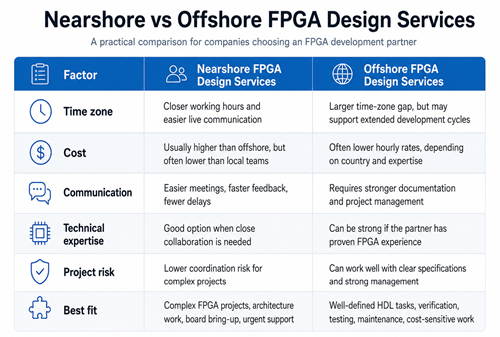
Understanding Nearshore and Offshore FPGA Design Services
Before comparing the two approaches, it is important to understand how nearshore and offshore FPGA services differ in practice.
What Is Nearshore FPGA Development
Nearshore FPGA development refers to working with engineering teams located in nearby regions with similar or overlapping time zones. For European companies, this often includes Eastern Europe, while US companies may work with Latin American teams.
The main benefit of nearshore collaboration is alignment. Teams can communicate during shared working hours, participate in real-time discussions, and quickly resolve issues. This is especially valuable in FPGA projects, where debugging and system integration often require immediate feedback.
Nearshore teams are commonly selected for complex platforms such as Xilinx UltraScale & UltraScale+ FPGA design services where tight collaboration and fast iteration cycles are essential.
What Is Offshore FPGA Development
Offshore FPGA development typically involves working with engineering teams located in regions with significant time zone differences, such as Asia. Offshore teams are often chosen due to cost advantages and access to a large pool of skilled engineers.
These teams are frequently used for well-defined tasks such as RTL implementation, verification, or IP integration. Offshore development can be highly effective when requirements are clear and project scope is stable.
For example, companies building scalable systems on Intel Agilex & Stratix FPGA platforms may leverage offshore teams to increase development capacity while maintaining cost efficiency.
Key Differences Between Nearshore and Offshore FPGA Services
Choosing between nearshore and offshore FPGA services requires evaluating several key factors that directly impact project execution.
Communication and Time Zone Alignment
Communication plays a critical role in FPGA development. Many challenges, such as timing closure issues or interface integration problems, require immediate discussion between engineers.
Nearshore teams enable real-time communication, allowing faster decision-making and shorter iteration cycles. Engineers can quickly review designs, troubleshoot issues, and adjust system architecture without delays.
This is particularly important in projects involving embedded platforms such as Xilinx Zynq & RFSoC FPGA design services, where hardware and software must be tightly coordinated.
Offshore teams, by contrast, often operate with limited overlapping working hours. While this can be managed with structured workflows, it can slow down communication and delay issue resolution.
Cost Structure and Overall Efficiency
Offshore FPGA services are typically more cost-effective in terms of hourly rates. This makes them attractive for projects with clearly defined deliverables and limited need for ongoing interaction.
However, lower hourly cost does not always mean lower total project cost. Communication delays, misunderstandings, and rework can increase overall development time.
Nearshore teams may have higher hourly rates but often deliver faster execution due to better communication and fewer coordination challenges. In complex FPGA projects, this can result in lower total cost despite higher rates.
When Nearshore FPGA Design Services Are the Better Choice
Nearshore FPGA development is particularly well suited for projects that require continuous collaboration and iterative design processes.
Complex System Integration
FPGA systems often involve multiple components, including ADCs, processors, memory, and communication interfaces. Integrating these elements requires frequent interaction between teams.
Nearshore engineers can participate in real-time design reviews, hardware debugging sessions, and integration testing. This is especially important in applications such as FPGA data acquisition systems where high-speed data streams must be captured and processed reliably.
Iterative Development and Debugging
Many FPGA projects evolve during development. Engineers may need to refine architectures, optimize performance, or adjust timing constraints.
In these situations, the ability to communicate quickly and iterate efficiently is critical. Nearshore teams enable rapid feedback loops, reducing delays and improving development efficiency.
When Offshore FPGA Design Services Make Sense
Offshore FPGA development can be highly effective when projects are structured with clear requirements and well-defined tasks.
Well-Defined RTL and Verification Work
Tasks such as RTL implementation, testbench development, and verification can often be executed efficiently by offshore teams.
For example, companies working on cost-sensitive platforms such as Intel Arria & Cyclone FPGA design services may use offshore teams for implementation while keeping architecture and integration closer to home.
Scaling Engineering Capacity
Offshore teams are often used to extend internal engineering capabilities. Companies can scale resources quickly without hiring full-time staff.
This is particularly useful for large FPGA projects or organizations managing multiple development efforts simultaneously.
Risks and Challenges in FPGA Outsourcing
Both nearshore and offshore models involve risks that must be managed carefully.
Requirements Definition and Knowledge Transfer
FPGA projects require detailed specifications and clear documentation. Miscommunication or unclear requirements can lead to delays or rework.
This risk is typically higher in offshore models due to time zone differences and reduced real-time interaction.
Hardware Debugging and Validation
Many FPGA issues only appear during hardware testing. Debugging these issues requires access to physical boards and lab equipment.
Coordinating hardware debugging across regions can be challenging, especially when working with offshore teams.
Hybrid FPGA Development Models
Many companies combine nearshore and offshore approaches to balance cost and efficiency.
Architecture Nearshore, Implementation Offshore
In this model, system architecture and integration are handled by nearshore or in-house teams, while offshore teams focus on implementation tasks such as RTL coding or verification.
This approach allows companies to maintain control over critical design decisions while benefiting from cost-effective development resources.
Distributed FPGA Engineering Teams
Some organizations operate distributed FPGA teams across multiple regions. This model requires strong project management, clear interface definitions, and structured workflows.
When executed well, it provides both flexibility and scalability.
How HardwareBee Helps You Choose the Right FPGA Partner
Selecting the right FPGA design partner involves more than comparing costs. Companies must evaluate technical expertise, communication capabilities, and experience with specific FPGA platforms.
HardwareBee enables companies to:
Identify FPGA design service providers across regions
Compare expertise in different FPGA technologies
Evaluate nearshore and offshore engagement models
Find partners suited for specific applications and industries
This helps companies make informed decisions and reduce risk in FPGA development projects.
The choice between nearshore and offshore FPGA design services depends on project complexity, budget, timeline, and collaboration requirements.
Nearshore teams provide better communication, faster iteration, and stronger alignment for complex projects. Offshore teams offer cost advantages and scalability for well-defined tasks.
In many cases, a hybrid model provides the best balance between efficiency and cost.
By selecting the right approach and working with experienced FPGA design partners, companies can improve execution, reduce risk, and successfully deliver high-performance systems.
Related FPGA Design Services
Xilinx UltraScale & UltraScale+ FPGA Design Services
Intel Agilex & Stratix FPGA Design Services
Xilinx Zynq & RFSoC FPGA Design Services
Intel Arria & Cyclone FPGA Design Services









 Partner with us