

The History of Texas Instruments: From the Integrated Circuit to Modern Analog Chips
09/11/2026, hardwarebee
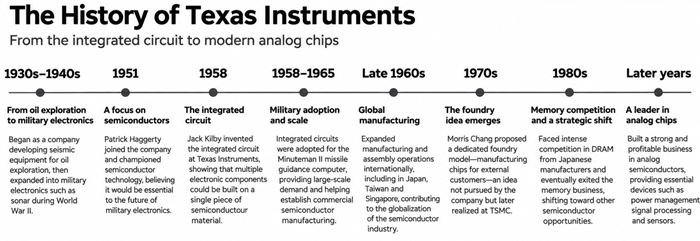
Texas Instruments (TI) is one of the most influential companies in the history of the semiconductor industry. From its early involvement in military electronics to the invention of the integrated circuit and its emergence as a leading manufacturer of analog semiconductors, the company has played a central role in shaping modern electronics.
Unlike semiconductor companies that built their businesses around microprocessors or memory chips, Texas Instruments eventually established a strong position in analog technologies, supplying components used to process signals, manage electrical power and connect electronic systems with the physical world.
However, the company’s path to becoming a semiconductor industry leader was far from straightforward. Its history includes groundbreaking inventions, military contracts, manufacturing innovations, international expansion and strategic decisions that influenced the development of the global semiconductor supply chain. It also includes missed commercial opportunities and the departure of engineers who would later transform the industry.
1. The Early Years: From Oil Exploration to Military Electronics
The origins of Texas Instruments lie in a business that initially had little connection to semiconductor manufacturing. The company’s early activities focused on developing equipment that used seismic waves to help oil companies identify underground geological formations and determine where to drill.
During World War II, this expertise in electronic measurement and signal detection became valuable to the United States military. The U.S. Navy needed sophisticated sonar systems capable of detecting enemy submarines, and the company was called upon to develop the necessary equipment.
The experience gained through military electronics created opportunities beyond oil exploration. After the war, Texas Instruments increasingly recognized that electronic systems would become essential components of military communications, navigation and weapons technologies.
One of the most important figures in this transformation was Patrick Haggerty, an electrical engineer who joined Texas Instruments in 1951. Haggerty believed that electronics would eventually become a central part of military technology and that semiconductor devices could replace larger, less reliable electronic components.
At the time, computers and electronic systems depended heavily on vacuum tubes and discrete components. These devices were bulky, consumed considerable amounts of electricity and required complex wiring. The development of the transistor at Bell Labs in 1947 created an opportunity to build smaller and more reliable electronic systems.
Texas Instruments recognized the commercial potential of the transistor and began building the engineering capabilities required to manufacture semiconductor devices.
2. Jack Kilby and the Invention of the Integrated Circuit
A defining moment in the history of Texas Instruments occurred in 1958 when engineer Jack Kilby joined the company’s semiconductor division in Dallas.
Kilby had previously worked at Centralab, where he gained experience with transistor technology. After joining Texas Instruments, he began investigating one of the most significant limitations of early electronic systems: the enormous number of wires required to connect individual transistors and other components.
Although transistors were considerably smaller than vacuum tubes, complex electronic systems still required thousands of separate connections. As the number of components increased, wiring became an obstacle to further miniaturization.
During the summer of 1958, while many of his colleagues were away on vacation, Kilby began considering an alternative approach. Instead of manufacturing transistors and other circuit components separately and connecting them through external wiring, he proposed integrating multiple components onto a single piece of semiconductor material.
This idea became the foundation of the integrated circuit, one of the most important inventions in modern technological history.
Kilby’s work demonstrated that electronic circuits could be constructed within a single semiconductor structure, dramatically reducing the complexity associated with traditional electronic assembly.
At approximately the same time, Robert Noyce and his colleagues at Fairchild Semiconductor were developing their own approach to integrated circuits. Noyce’s work focused on manufacturing methods that would allow circuits to be produced efficiently on silicon wafers.
The competing inventions led to years of patent litigation between Texas Instruments and Fairchild Semiconductor. Nevertheless, the contributions of both Kilby and Noyce became fundamental to the development of the semiconductor industry.
Kilby was awarded the Nobel Prize in Physics in 2000 for his contribution to the invention of the integrated circuit.
3. The U.S. Military Becomes an Early Customer for Integrated Circuits
Although the integrated circuit represented a technological breakthrough, its commercial success was not immediately guaranteed. Early chips were expensive to manufacture, production yields were uncertain and many potential customers remained skeptical about their reliability.
Patrick Haggerty understood that the military could become an important early market for the new technology. Military systems frequently required electronic equipment that was smaller, lighter and more reliable than conventional alternatives.
Soon after Kilby’s invention, Haggerty began presenting the technology to the U.S. Department of Defense. In 1959, the Air Force Avionics Laboratory agreed to support Texas Instruments’ semiconductor research, creating opportunities for additional military contracts.
The decisive breakthrough came with the Minuteman II intercontinental ballistic missile program. The missile required a compact guidance computer capable of performing calculations while operating under demanding conditions.
Conventional guidance computers used discrete transistors and extensive wiring, making them heavy and difficult to miniaturize. Texas Instruments proposed replacing much of this circuitry with integrated circuits.
The company’s engineers developed a design in which approximately 95% of the computer’s functions could be performed by integrated circuits weighing only a few ounces. The remaining components were considerably heavier, demonstrating the extraordinary potential of semiconductor integration.
Winning the Minuteman II contract transformed Texas Instruments’ integrated circuit business. Instead of selling chips in quantities measured in dozens, the company began manufacturing thousands of devices for military applications.
By the end of 1964, Texas Instruments had supplied approximately 100,000 integrated circuits to the Minuteman program. In 1965, the program accounted for roughly one-fifth of all integrated circuits sold that year.
Military demand played a crucial role in establishing semiconductor manufacturing as a commercially viable industry. It provided Texas Instruments with both revenue and an incentive to improve the efficiency, reliability and scale of integrated circuit production.
4. Developing the Technology for Mass Semiconductor Manufacturing
Inventing the integrated circuit was only the beginning. Producing thousands of identical, reliable semiconductor devices required manufacturing capabilities that barely existed during the late 1950s.
One of the important developments came from engineer Jay Lathrop, who joined Texas Instruments in September 1958. While previously working on military electronics, Lathrop and his colleague James Nall had developed a technique for creating extremely small semiconductor patterns using light-sensitive chemicals.
Their method, known as photolithography, made it possible to transfer precise patterns onto semiconductor materials. By exposing photoresist-coated surfaces to light through specially prepared patterns, engineers could define miniature structures with considerably greater accuracy than earlier mechanical methods.
Texas Instruments recognized that photolithography could help solve the manufacturing challenges associated with integrated circuits. However, adapting the process for commercial semiconductor production required extensive experimentation.
Available photoresist chemicals were not sufficiently pure, forcing Texas Instruments to develop additional purification procedures. Existing suppliers also struggled to produce masks with the required precision, leading the company to manufacture some of its own materials and equipment.
Production engineers worked continuously to understand how temperature, pressure, chemical purity and other variables affected semiconductor yields. Even small variations could cause entire production batches to fail.
Mary Anne Potter, a production engineer at Texas Instruments, played an important role in improving manufacturing processes for the Minuteman missile program. She conducted extensive experiments, collected production data and performed calculations to identify conditions that improved manufacturing consistency.
These efforts established a fundamental principle of semiconductor manufacturing: successful chip production depends not only on circuit design but also on precise control of thousands of manufacturing variables.
5. Morris Chang and the Importance of Semiconductor Yields
Another important figure in Texas Instruments’ early semiconductor operations was Morris Chang, who joined the company in 1958.
Chang had studied engineering at MIT and previously worked at Sylvania, where he gained experience improving transistor manufacturing yields. At Texas Instruments, he was assigned responsibility for a production line manufacturing transistors for IBM computers.
The production line initially suffered from extremely low yields, with many devices failing because of manufacturing defects.
Chang approached the problem systematically, studying the effects of different manufacturing conditions and adjusting production parameters to improve the percentage of working devices.
Within months, his efforts increased yields to approximately 25%, a significant improvement over the original results. His success attracted the attention of senior executives and helped establish his reputation as an exceptionally capable manufacturing engineer.
Chang eventually assumed responsibility for Texas Instruments’ integrated circuit business and became deeply involved in the company’s international semiconductor manufacturing operations.
His experience demonstrated how manufacturing knowledge could provide a competitive advantage. Semiconductor companies that produced higher yields could reduce costs, improve delivery reliability and invest more effectively in future technology development.
The expertise Chang developed at Texas Instruments would later influence one of the most important changes in the global semiconductor industry: the creation of the dedicated semiconductor foundry business model.
6. Entering Consumer Electronics: Calculators and Missed Opportunities
As semiconductor manufacturing improved during the 1960s, Texas Instruments began exploring opportunities beyond military electronics.
One of the most promising markets was consumer electronics, where integrated circuits could make products smaller, cheaper and more reliable.
Texas Instruments had already experimented with transistor radios, but the company struggled to market them successfully. Japanese manufacturers, particularly Sony, recognized the opportunity more effectively and established strong positions in the growing consumer electronics industry.
A similar situation emerged with electronic calculators.
In 1967, Patrick Haggerty asked Jack Kilby to develop a handheld calculator powered by semiconductor technology. The concept demonstrated how integrated circuits could replace the complex electronic circuitry used in larger calculating machines.
However, Texas Instruments’ marketing organization remained uncertain about the commercial potential of inexpensive handheld calculators. As a result, the company’s early development work did not immediately translate into market leadership.
Japanese electronics manufacturer Sharp pursued the opportunity more aggressively, producing calculators that incorporated American semiconductor technology and became increasingly affordable.
During the 1970s, Japanese manufacturers dominated the calculator market, demonstrating the growing importance of combining semiconductor technology with effective product design and marketing.
For Texas Instruments, the experience revealed an important distinction between technological innovation and commercial success. Possessing advanced semiconductor technology did not automatically guarantee leadership in the consumer products built around it.
7. Texas Instruments and the Globalization of Semiconductor Manufacturing
Texas Instruments also played an important role in the international expansion of semiconductor manufacturing.
During the 1960s, American semiconductor companies began establishing manufacturing and assembly operations in Asia, where lower labor costs created opportunities to reduce production expenses.
Fairchild Semiconductor was among the first American chip companies to move semiconductor assembly to Asia, establishing operations in Hong Kong. Texas Instruments, Motorola and other companies soon followed.
Texas Instruments expanded its international activities through relationships with governments and electronics manufacturers in several Asian countries.
In Japan, the company initially encountered substantial regulatory barriers when attempting to establish semiconductor manufacturing operations. Akio Morita, the co-founder of Sony, helped Texas Instruments navigate these restrictions through a proposed partnership in which Texas Instruments would manufacture semiconductor devices while Sony assisted with local negotiations.
The relationship eventually enabled Texas Instruments to establish semiconductor manufacturing operations in Japan.
Taiwan became another important location for the company. Morris Chang encouraged Texas Instruments to consider establishing operations on the island, where government officials were eager to attract foreign investment and advanced industrial expertise.
In July 1968, the Texas Instruments board approved construction of a semiconductor facility in Taiwan. The plant began assembling devices in August 1969 and had shipped its billionth unit by 1980.
Texas Instruments also established semiconductor assembly operations in Singapore with government support, contributing to the expansion of Southeast Asia’s electronics industry.
These investments formed part of a broader transformation in which semiconductor production became increasingly international. Design, wafer fabrication, assembly and testing could take place in different countries, creating the foundations of the global semiconductor supply chain.
8. A Missed Opportunity: The Birth of the Semiconductor Foundry Concept
One of the most consequential developments associated with Texas Instruments involved an idea proposed by Morris Chang during the 1970s.
At that time, semiconductor companies generally designed and manufactured their own chips. Companies such as Texas Instruments, Intel and Motorola maintained integrated operations in which product development and semiconductor fabrication were closely connected.
Chang believed that this business model would eventually face economic limitations.
As semiconductor technology advanced, manufacturing equipment and research expenditure were becoming increasingly expensive. Companies would need enormous production volumes to justify investment in advanced fabrication facilities.
In March 1976, Chang proposed a different approach to his colleagues at Texas Instruments. Instead of manufacturing only its own semiconductor designs, a company could specialize in producing chips designed by external customers.
This approach would enable semiconductor designers to develop new products without financing their own fabrication plants.
Chang also anticipated that declining computing costs would create new markets for semiconductors in applications such as automobiles, telephones and household equipment.
Texas Instruments’ management was not convinced. The company was already profitable under its existing business model, and there were few semiconductor design companies operating without their own manufacturing facilities.
The proposal was not pursued.
Years later, after leaving Texas Instruments, Chang moved to Taiwan and helped establish Taiwan Semiconductor Manufacturing Company (TSMC), applying the dedicated foundry concept that he had previously considered.
TSMC’s subsequent growth transformed the semiconductor industry by enabling the expansion of fabless semiconductor companies.
The history of Texas Instruments is therefore closely connected not only to the invention of integrated circuits but also to the emergence of the modern semiconductor foundry business model.
9. The Memory Chip Industry and Increasing Competition
During the 1970s and 1980s, semiconductor manufacturers faced growing competition as memory chips became an increasingly important market.
Dynamic random-access memory (DRAM) represented one of the semiconductor industry’s most demanding businesses. Manufacturers continually needed to increase memory capacity, reduce production costs and improve manufacturing yields.
American semiconductor companies initially played a leading role in DRAM development, but Japanese manufacturers became formidable competitors.
Companies such as Toshiba, NEC and Fujitsu invested heavily in memory technology, manufacturing efficiency and quality improvements.
The competitive pressure intensified during the 1980s, when many American semiconductor manufacturers struggled to remain profitable in DRAM production.
Texas Instruments continued manufacturing DRAM devices but encountered significant difficulties generating attractive financial returns.
Although the company possessed considerable semiconductor expertise, technological capabilities alone were insufficient to guarantee profitability in a market characterized by falling prices and aggressive competition.
Texas Instruments eventually sold its DRAM operations to Micron Technology, which had established a more competitive position through manufacturing efficiency and cost control.
The experience illustrated how different semiconductor markets required different business strategies. Memory manufacturing increasingly rewarded companies that could combine enormous scale with continuous process improvements, while other semiconductor categories offered opportunities based on specialized design capabilities and product differentiation.
10. The Evolution Toward Analog Semiconductor Technologies
As the semiconductor industry matured, its products increasingly fell into three broad categories: logic, memory and a diverse group of analog and specialized semiconductor devices.
Logic chips, including microprocessors, became central to computers, servers and digital systems. Memory chips provided temporary and long-term data storage, while analog and specialized semiconductors performed functions involving electrical signals, sensors, communications and power management.
These categories developed under different technological and economic conditions.
For advanced logic and memory chips, continued improvements in transistor density became a central competitive requirement. Manufacturers invested heavily in increasingly sophisticated fabrication equipment to produce smaller semiconductor features.
Analog semiconductor devices followed a different development path.
Many analog circuits did not require the smallest available transistors. Instead, their performance depended heavily on circuit architecture, electrical characteristics, specialized device structures and careful semiconductor design.
A substantial proportion of analog and related semiconductor products continued to be manufactured using established process technologies, including nodes of 180nm and larger.
This created a different manufacturing environment from leading-edge logic production. Semiconductor fabs producing analog devices often required significantly less capital investment than the most advanced processor or memory fabrication facilities.
Texas Instruments developed a particularly strong position in this part of the semiconductor industry.
Rather than establishing a dominant position in PC processors, data-center processors or smartphone application processors, the company built an extensive catalog of analog semiconductor devices and sensors.
This business became an important source of profitability, demonstrating that semiconductor companies could succeed without competing directly in the race toward the smallest transistor geometries.
11. Why Analog Semiconductors Became an Important Business
The development of Texas Instruments’ analog semiconductor business highlights an important characteristic of the electronics industry: digital processing is only one part of an electronic system.
Electronic devices must also interact with physical signals, manage electrical energy and communicate with other components.
Analog semiconductors serve many of these functions, making them essential across a broad range of applications.
Unlike advanced digital processors, whose competitive advantage often depends on transistor density and computing performance, analog circuits frequently derive value from specialized electrical characteristics and circuit design.
For semiconductor manufacturers, this creates opportunities to develop products that remain commercially useful without requiring continuous migration to the latest process node.
Established manufacturing technologies can therefore continue supporting valuable semiconductor products long after they cease to represent the leading edge of transistor scaling.
This difference also affects the structure of the semiconductor market.
While advanced logic and memory production increasingly concentrated among a small number of manufacturers with enormous fabrication facilities, analog semiconductor manufacturing remained more geographically diversified.
Major analog manufacturers continued operating in the United States, Europe and Japan, reflecting the different economics of their products.
Texas Instruments emerged as the largest analog semiconductor manufacturer during this period, demonstrating the commercial potential of a strategy focused on a broad range of specialized semiconductor components rather than a single dominant computing platform.
12. The Legacy of Texas Instruments in the Semiconductor Industry
The history of Texas Instruments reflects several of the most important transformations in the semiconductor industry.
The company’s early work in military electronics helped establish demand for integrated circuits when the technology was still expensive and difficult to manufacture. Jack Kilby’s invention demonstrated that electronic circuits could be integrated onto a single semiconductor substrate, while the company’s manufacturing engineers developed techniques that made large-scale production possible.
Texas Instruments also contributed to the internationalization of semiconductor manufacturing through its operations in Japan, Taiwan and Singapore. These investments helped establish production capabilities and industrial relationships that became fundamental to the global semiconductor supply chain.
Its role in training engineers was equally significant. Morris Chang developed much of his semiconductor manufacturing expertise at Texas Instruments before establishing TSMC and helping transform the relationship between chip design companies and foundries.
At the same time, Texas Instruments’ experiences in calculators, consumer electronics and DRAM demonstrated that technological innovation did not always translate into commercial leadership.
The company’s eventual strength in analog semiconductors illustrates another important lesson: semiconductor success does not depend exclusively on producing the most advanced logic chips.
Specialized technologies, manufacturing expertise and the ability to serve diverse electronic applications can be equally important sources of long-term competitive advantage.
Conclusion
Texas Instruments has occupied an important position in semiconductor history for more than half a century. From its beginnings in seismic equipment and military electronics to its role in inventing the integrated circuit, the company contributed to technological developments that made modern electronics possible.
Its manufacturing innovations helped transform integrated circuits from laboratory inventions into mass-produced components, while its international expansion contributed to the development of semiconductor supply chains across Asia.
The company’s involvement in memory chips, consumer electronics and the early development of the foundry concept also demonstrates how the semiconductor industry evolved through competition, experimentation and changing business models.
Ultimately, Texas Instruments’ evolution into a leading analog semiconductor manufacturer illustrates that progress in the semiconductor industry is not measured solely by smaller transistors or greater computing power. It also depends on the ability to develop practical, reliable and economically viable semiconductor technologies that support the enormous diversity of modern electronic systems.







 Partner with us